The Myelodysplastic Syndromes Channel is supported with funding from Geron (Silver).
VJHemOnc is an independent medical education platform. Supporters, including channel supporters, have no influence over the production of content. The levels of sponsorship listed are reflective of the amount of funding given to support the channel.
ASH 2025 | Improving diagnostic procedures in MDS to avoid invasive bone marrow examination
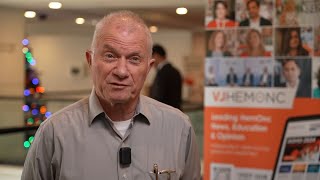
In this video, Moshe Mittelman, MD, Tel Aviv Sourasky Medical Center, Tel Aviv, Israel, discusses the development and validation of non-invasive diagnostic algorithms for myelodysplastic syndromes (MDS) that can also identify pre-MDS states without the need for invasive bone marrow examination. This interview took place at the 67th ASH Annual Meeting and Exposition, held in Orlando, FL.
These works are owned by Magdalen Medical Publishing (MMP) and are protected by copyright laws and treaties around the world. All rights are reserved.
Transcript
Yes, I will start with a short introduction. I’m not Martin Luther King, but I also have a dream, another dream. And my dream is that one day, patients will be able to undergo diagnostic procedures which will be easier without bone marrow biopsy and bone marrow aspiration. And to that end, we have been doing for several years several studies. So we started in our local center in Tel Aviv a small study in which we tried to take digital and simple lab values and to try by doing kind of mathematics and formula to establish a small algorithm to diagnose...
Yes, I will start with a short introduction. I’m not Martin Luther King, but I also have a dream, another dream. And my dream is that one day, patients will be able to undergo diagnostic procedures which will be easier without bone marrow biopsy and bone marrow aspiration. And to that end, we have been doing for several years several studies. So we started in our local center in Tel Aviv a small study in which we tried to take digital and simple lab values and to try by doing kind of mathematics and formula to establish a small algorithm to diagnose. This was okay, but this was not perfect.
So then together with a joint project with the European MDS group, we have tested 500 patients with MDS and compared their data to 500 individuals who had bone marrow but all did not have MDS. And by comparing many data and many variables and many simple parameters of these patients, as well as the controlled individuals, we were able to establish a very simple algorithm based on 10 simple, easily available parameters such as age, sex, hemoglobin, white blood cells, monocyte count, platelet count. Very simple, easily available parameters that every patient or every physician in the community has. And by adding these parameters of the suspected individuals in the algorithm you can get a line and a line and you can get a score which shows you whether this suspected has or does not have MDS and this is quite accurate in about 85% of the suspected individuals. So this is the algorithm which was published about three or four years ago.
And any such a system, any such model has to be validated. So there are two validations. One is our validation, but using data of patients whose data were not included in the establishing of the algorithm. But you may say, well, this is a local validation. So there is another validation made by the German group of Düsseldorf. They took their own data and they validated the model. Now, this year in ASH, we are presenting another extension of that study. We took suspected patients who have CCUS and ICUS, which are pre-MDS states. These are people who do not have MDS yet, but they have some findings which make them at the status of pre-MDS, and obviously some of them will, and others will not develop MDS in the future. So we were able to show that the model works fairly nicely and can identify these individuals. It can distinguish between them and MDS and between them and normal. So we are going to continue to work on that. One of the future steps is to incorporate genetic data into this model and to make it even more accurate. So the bottom line, and if you want the title, is how we can improve diagnostic procedures and avoid the invasive bone marrow examination, which patients, and I don’t blame them, don’t like.
This transcript is AI-generated. While we strive for accuracy, please verify this copy with the video.
Read more...