The Community Focus Channel is supported with funding from Johnson & Johnson (Gold).
The Lymphoma Channel is supported with funding from AstraZeneca (Diamond), BMS (Gold), Johnson & Johnson (Gold), Takeda (Silver) and Galapagos (Bronze).
VJHemOnc is an independent medical education platform. Supporters, including channel supporters, have no influence over the production of content. The levels of sponsorship listed are reflective of the amount of funding given to support the channel.
ASH 2025 | Improving CAR T-cell therapy referral patterns of patients with R/R LBCL in the US
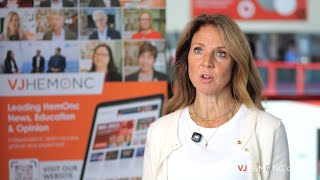
In this video, Tara Graff, DO, Mission Cancer and Blood, Des Moines, IA, discusses the challenge of improving CAR T-cell therapy referral patterns of patients with relapsed/refractory (R/R) large B-cell lymphoma (LBCL) in the United States. Dr Graff emphasizes the importance of better communication and education of community physicians on when to refer patients, as well as a multidisciplinary approach to patient management. This interview took place at the 67th ASH Annual Meeting and Exposition, held in Orlando, FL.
These works are owned by Magdalen Medical Publishing (MMP) and are protected by copyright laws and treaties around the world. All rights are reserved.
Transcript
With this abstract, we really know that there’s an unmet need for referral patterns for CAR-T patients, right? We have all these wonderful products available, yet not enough patients are getting to CAR-T. I mean, the numbers are actually quite dismal when you think about it. There are patients that are very close to the academic centers that, you know, it’s easy...
With this abstract, we really know that there’s an unmet need for referral patterns for CAR-T patients, right? We have all these wonderful products available, yet not enough patients are getting to CAR-T. I mean, the numbers are actually quite dismal when you think about it. There are patients that are very close to the academic centers that, you know, it’s easy. They’re right there. There are patients who tend to live far, far away who are getting to referral centers. Yet it’s the patients that are actually kind of geographically close to CAR-T centers, but maybe an hour away that aren’t getting there, right? So it’s very interesting. So what do you do with this group in the middle? How do we improve on this? Is it, you know, better communication and education of community physicians on when to refer? You know, is it partnering a community physician with an academic or CAR-T treating physician to have a better seamless, kind of back and forth highway on co-management? I think what happens sometimes is that patients are afraid to leave their primary oncologist and go to another center and fear that they’re not going to come back home, and I think some of that probably exists for the physician as well. So I think we really need to set up, one, more education around the landscape, which you see is changing constantly just being here, but also have a better multidisciplinary approach to these patients and management of these patients to get them to CAR-T sooner and to capture more than 20% referrals and patients actually getting CAR-T.
This transcript is AI-generated. While we strive for accuracy, please verify this copy with the video.
Read more...