The Community Focus Channel is supported with funding from Johnson & Johnson (Gold).
The Myeloproliferative Neoplasms Channel is supported with funding from Takeda (Gold) and Kartos Therapeutics, Inc. (Bronze).
VJHemOnc is an independent medical education platform. Supporters, including channel supporters, have no influence over the production of content. The levels of sponsorship listed are reflective of the amount of funding given to support the channel.
ASH 2025 | Preventing or reversing transfusion dependence to improve outcomes in myelofibrosis
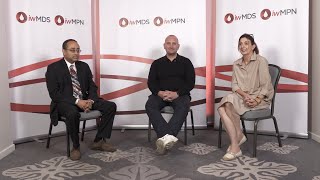
In this video, Haifa Kathrin Al-Ali, MD, University Hospital Halle, Halle, Germany, briefly discusses the importance of preventing or reversing transfusion dependence in patients with myelofibrosis (MF), highlighting that it is one of the strongest predictive factors of poor outcomes. This interview took place at the 67th ASH Annual Meeting and Exposition, held in Orlando, FL.
These works are owned by Magdalen Medical Publishing (MMP) and are protected by copyright laws and treaties around the world. All rights are reserved.
Transcript
Anemia of all the risk scores is one of the bad prognostic factors and more than anemia it is actually the transfusion dependency, which has a really very great negative impact on the survival of our patients and the goal is always to try to prevent transfusion dependency or if we have patients that are transfusion dependent, to make them transfusion independent. And indeed, if you look at the DIPSS Plus model, but also our own data we presented at EHA this year, that transfusion dependency and not anemia alone, under the available JAK inhibitors, emerges as the highest risk factor for survival, even after allogeneic stem cell transplantation...
Anemia of all the risk scores is one of the bad prognostic factors and more than anemia it is actually the transfusion dependency, which has a really very great negative impact on the survival of our patients and the goal is always to try to prevent transfusion dependency or if we have patients that are transfusion dependent, to make them transfusion independent. And indeed, if you look at the DIPSS Plus model, but also our own data we presented at EHA this year, that transfusion dependency and not anemia alone, under the available JAK inhibitors, emerges as the highest risk factor for survival, even after allogeneic stem cell transplantation. And with all the emerging data on the TGF-beta ligand traps like luspatercept, but also the JAK inhibitors like Momelotinib or Pacritinib, we are now seeing a kind of a paradigm change, meaning that we could, with medical therapy, improve the survival of our patients if we manage to prevent transfusion dependency or make transfusion-dependent patients transfusion-independent.
This transcript is AI-generated. While we strive for accuracy, please verify this copy with the video.
Read more...