The Acute Myeloid Leukemia Channel is supported with funding from BMS (Silver), and through an educational grant from Jazz Pharmaceuticals.
VJHemOnc is an independent medical education platform. Supporters, including channel supporters, have no influence over the production of content. The levels of sponsorship listed are reflective of the amount of funding given to support the channel.
EHA 2025 | Prolonging remission in AML: stem cell transplantation or continuous treatment
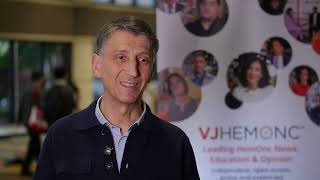
Gail Roboz, MD, Weill Cornell Medicine, New York City, NY, discusses strategies for prolonging remission in patients with acute myeloid leukemia (AML). Dr Roboz highlights that stem cell transplantation or continuous treatment can be used, and emphasizes the need to tailor maintenance better to improve the rates of cure. This interview took place at the 30th Congress of the European Hematology Association (EHA) in Milan, Italy.
These works are owned by Magdalen Medical Publishing (MMP) and are protected by copyright laws and treaties around the world. All rights are reserved.
Transcript
Everyone wants to stay in remission when you get in remission. Remission is the safe zone, relapsed AML is dangerous. So we have two ways to stay in remission with ongoing treatment or with a stem cell transplant. One of the interesting themes that came up at the meeting was once you get a transplant, I think patients and doctors think that okay, the transplant is done, your blood counts have recovered, you’re done, you’re cured...
Everyone wants to stay in remission when you get in remission. Remission is the safe zone, relapsed AML is dangerous. So we have two ways to stay in remission with ongoing treatment or with a stem cell transplant. One of the interesting themes that came up at the meeting was once you get a transplant, I think patients and doctors think that okay, the transplant is done, your blood counts have recovered, you’re done, you’re cured. Actually, the transplant needs time to kick in. And there’s post-transplant maintenance studies ongoing to try to see whether if you give some opportunity, if you give several months for the graft versus leukemia effect to kick in by having some maintenance after the transplant, might you actually cure more of the patients? And these studies, we are waiting for data still to read out. So post-transplant maintenance is its own kind of separate area. For the patients not going into transplant, we have an approved agent for intensively treated patients, which is oral azacitidine. But of course, that’s prolonging remission primarily. It’s not curing the majority of patients. So the question is, how do we layer on or tailor maintenance better to improve the rates of cure? And I would say these are very difficult trials to accrue. We’ve learned that it takes a long time, but maintenance efforts are ongoing and we are also trying to optimize measurements of measurable residual disease so that if patients are achieving very, very deep remissions perhaps they could be taken off of maintenance whereas if patients are continuing to show evidence of residual disease perhaps we then have a signal to continue and to have a sense that who actually is benefiting from ongoing therapy versus those who might be okay without it.
This transcript is AI-generated. While we strive for accuracy, please verify this copy with the video.
Read more...