



Podcasts
Listen to the latest hemonc news from international experts
The Acute Myeloid Leukemia Channel is supported with funding from BMS (Silver), and through an educational grant from Jazz Pharmaceuticals.
The Chronic Lymphocytic Leukemia Channel is supported with funding from AstraZeneca (Diamond), AbbVie (Platinum), BeOne Medicines (Silver) and Lilly (Silver).
The Multiple Myeloma Channel is supported with funding from BMS (Gold) and Legend Biotech (Bronze).
VJHemOnc is an independent medical education platform. Supporters, including channel supporters, have no influence over the production of content. The levels of sponsorship listed are reflective of the amount of funding given to support the channel.
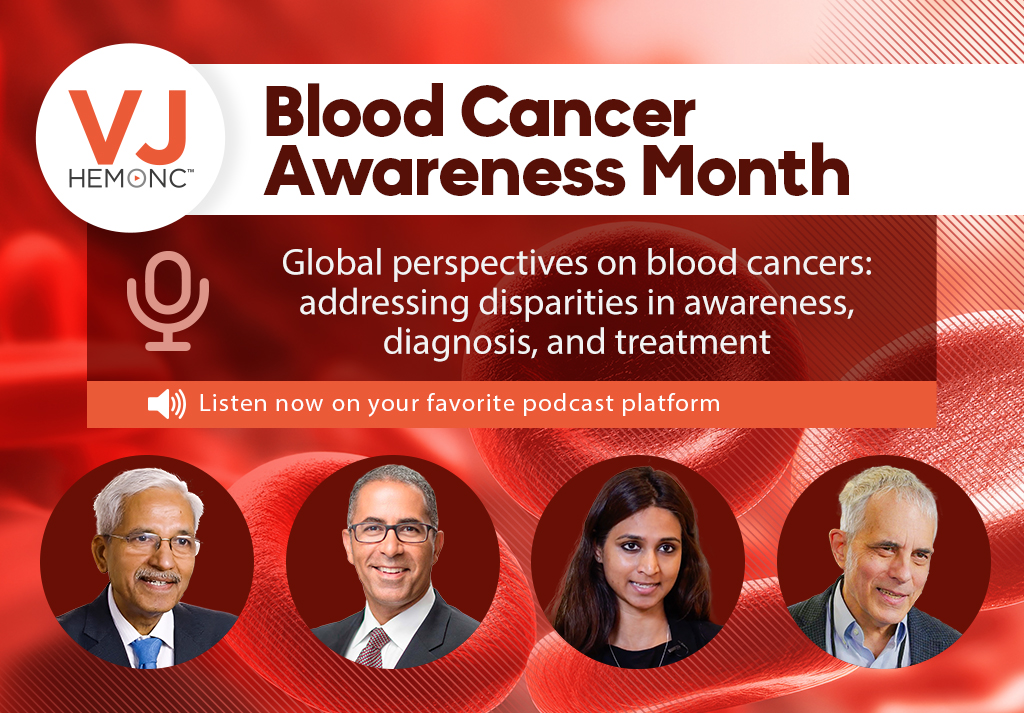
Global perspectives on blood cancers: addressing disparities in awareness, diagnosis, and treatment
Welcome to the first episode of VJHemOnc’s Blood Cancer Awareness Month special series!
This episode focuses on global perspectives of blood cancers and addresses the disparities that exist in awareness, diagnosis, and treatment. First, Lalit Kumar, MD, MBBS, Artemis Hospital, New Delhi, India, discusses challenges that exist in the management of blood cancers in India, and programs that are in place to address these. Joseph Mikhael, MD, MEd, FRCPC, FACP, Translational Genomics Research Institute (TGen), Phoenix, AZ, then goes on to address racial disparities in the treatment of multiple myeloma in America. Amrutha Sridhar, MBBS, University College London Hospitals, London, UK, discusses socioeconomic and racial disparities in myeloma trial recruitment, followed by Brian Koffman, MDCM (retired), MS Ed, CLL Society, Inc., Chula Vista, CA, who shares insights into a survey investigating global disparities in access to treatment and resources for patients with chronic lymphocytic leukemia in low-income countries.
Date: 9th September 2024
Transcript
Hello and welcome to today’s VJHemOnc podcast. We are a global open-access video journal bringing you the latest in hematology and hematological oncology. This month is Blood Cancer Awareness Month and in recognition we will be producing a special podcast series covering a variety of topics. Today’s episode focuses on global perspectives of blood cancers and addressing the disparities that exist...
Hello and welcome to today’s VJHemOnc podcast. We are a global open-access video journal bringing you the latest in hematology and hematological oncology. This month is Blood Cancer Awareness Month and in recognition we will be producing a special podcast series covering a variety of topics. Today’s episode focuses on global perspectives of blood cancers and addressing the disparities that exist.
First you will hear from Lalit Kumar who shares insights into the awareness of blood cancers in India and challenges that exist in their diagnosis and treatment.
Lalit Kumar
Actually, there have been very few studies on the awareness for particular blood cancers or leukemia in India. In fact, I would say in general, the awareness for cancers in general is not so high. So, there are many reasons for it. Now, based on the population-based cancer registry, which are 38 at the moment, and we have almost 250 hospital-based cancer registries, which report the data to the Indian Council of Medical Research, which is one of the health agencies, which collects the data or the cancer registry data from all over the country. And still it covers nearly 14 to 15 percent of the whole population. So the data suggests that incidence of leukemia, acute leukemia in children and acute myeloid leukemia in adults and chronic leukemia, chronic myeloid leukemia and chronic lymphocytic leukemia in general is lower compared to the Western world. But the typing of, I would say, acute lymphoblastic leukemia accounts for nearly about 29.3% of all cancers in children. And similarly, the acute myeloid leukemia, which accounts for nearly, acute and chronic myeloid leukemia account for 70% of all leukemias in children and then the adults. So, among adults, we have the chronic myeloid leukemia, which is one of the most common subtypes. When elderly, like similar to the Western world, we have the chronic lymphocytic leukemia, which is higher. But the incidence compared to the Western world has been low. But now with the last 10 or 15 years, gradually the number of chronic lymphocytic leukemia, CLL, is gradually rising.
One of the challenges which we normally come across, apart from the awareness of the public in general, especially in the rural areas and some of the areas which are not shown in the mainstream. So there the people may not have much knowledge about the cancer in general and also about the blood cancer. So, as a result, the second main challenge comes because of the availability of the diagnosis. Well, the diagnosis of leukemia in general, generally the standard as per the international data for major teaching hospitals is there. So, but in the district hospitals or primary health centers, obviously, the diagnosis of leukemia, sometimes they will just suspect leukemia and they will refer you to the higher center. So, it has been one of the major issues. So, by the time patient comes to higher centers, it’s a little late in that sense, especially in the acute leukemia when the patient generally may be more sicker compared to the chronic leukemia. And the second thing, like I would say that since many of the facilities in the remote area is limited, especially from the treatment, so people have to come from the remote areas or from far off distance to the major cities where the facilities for treatment are available.
Secondly, in terms of diagnostic work, which we do for acute leukemia, apart from the typing or characterization of acute leukemia, we also have a problem with the chromosomal or cytogenetic test or FISH test, which again is limited only in the major centers, not in the smaller places. And then thirdly, for monitoring of acute leukemia nowadays, we have the facilities for the MRD, or we earlier used to call it minimal residual disease, but nowadays it’s called measurable residual disease. So it has become one of the standard of care internationally for acute lymphoblastic leukemia, and similarly picking up for the acute myeloblastic leukemia. While I would say the facilities are available in the major teaching hospitals or tertiary care centers, but again, they are very, very limited. Or non-existent in the smaller places or district hospitals or even most of the medical colleges. So these are some of the, I would say, issues which we really come across for acute leukemia.
Chronic myeloid leukemia, for example, has been relatively a little easier. The diagnosis has been easier because it has been more on the clinical, and blood [INAUDIBLE] on the bone marrow cytogenetic test, which I think most hospitals, including the peripheral medical colleges, district hospital, these facilities are available. So most medical colleges are able to make the diagnosis of chronic myeloid leukemia or chronic lymphocytic leukemia. And secondly, the major change which since year 2000 happened, that availability of the imatinib mesylate or Gleevec, that time it was called. Now we have the generic formulation available in India, which is much cheaper. And so most people are able to afford it, which really has made a huge change in the terms of outcome, improvement in the overall survival.
I will also acknowledge here, The Max Foundation started a GIPAP program, Glivec International Patient Access Program, which I think they are running in many countries and including India. So a lot of people got benefited with this free medication and some of them are still probably continuing to get the free medication.
Next, Joseph MikHael addresses racial disparities in the treatment of multiple myeloma in America. He cites systemic issues, delayed diagnoses, and a lack of access to therapies as reasons for poorer survival rates among Black American and Hispanic Latino patients.
Joseph Mikhael
So health disparities has thankfully become placed into the spotlight of what we do in medicine. Obviously, I’m a bit interested in this both personally and professionally as an African American man, but also as someone who does a lot of work in this field. And although we often think of these things as maybe being specific to the U.S., there are equivalents of this really around the planet. The reality is that the data is striking.
So here in the United States, we know, for example, that those of us of African descent are twice as common, it is twice as common to have the diagnosis of myeloma. And that really is an international phenomenon, not just here in the U.S. But the sad reality is that the average survival of a black man or a black woman with myeloma is half that of a white man or a white woman with myeloma of the same age. That’s really mitigated by a whole series of factors.
We sought to outline this in the papers that we’ve been working on, the initiatives that we’ve been addressing. It really has a multifold complexity that I’ll just quickly summarize to say that there are systemic phenomenon within this society, whether it be systemic racism, lack of trust within the healthcare system. Indeed, secondly, the healthcare system itself and the way the insurance is built here does sadly lead to a greater disparity. And then there are those social determinants of health that we know just affect all of us, socioeconomic status, access to the basics of life. So with those three as sort of the basic societal health care and economic realities.
Then there are myeloma-specific reasons for why the disparity is so great, primarily in two major areas, is the delayed diagnosis. So we know that the average patient takes three visits with their primary care with signs and symptoms consistent with myeloma before the diagnosis is suspected and confirmed. That’s even longer in African-Americans and in Latino and Hispanic Americans, often because of a lack of access to the system, but also confounding diagnoses like diabetes. And then the second major area is access to these great therapies that we have. And in fact, I often argue that we have four different waves of therapy that have so influenced survival in myeloma, and they all start with the letter T. Triplets or three combinations, transplants or autologous stem cell transplant, clinical trials, and more recently, CAR T-cell therapy. And sadly, we’ve demonstrated that in all four, there’s been reduced access for certain populations, namely the African-American and Latino-American population.
So the stats are rather grim. On the other hand, there’s a lot of work being done to overcome this, to build greater inherent trust in the system, to have us recognize the deficiencies within the healthcare system, for us to address the social determinants of health and not just the disease as it were. And then to work very hard to educate our primary care colleagues to reduce the time to diagnosis and then work within the myeloma specific sphere to enhance access to care. And so I’ve had the privilege as the chief medical officer of the International Myeloma Foundation to lead our M-Power initiative, which is really designed to improve the short and long-term outcomes of patients that have historically been underrepresented in myeloma.
So there’s a lot of work to be done, but I think we have a blueprint of how we can do this. And it really requires tremendous collaboration across the medical and the non-medical system to raise awareness of these issues and to address them specifically.
You will now hear from Amrutha Sridhar who will discuss a study investigating socio-economic and racial disparities in myeloma trial recruitment.
Amrutha Sridhar
Very lucky to work on this project which was looking at access to clinical trials at UCLH. We’re a sizeable clinical trial centre in London where we offer standard of care therapy, early phase clinical trials and late phase clinical trials. And we were looking at the cohort of patients that are coming into our services and seeing the distribution of the socioeconomic backgrounds, as well as ethnicity to see whether there is a cohort of patients who are underrepresented. Because ideally in clinical trials, and indeed with standard of care therapy, you want good access to all cohorts of patients, irrespective of their background.
So, in our study, we looked at the patients who’d been through our service over the last 10 years and found that there was an underrepresentation of ethnic minorities, but also an underrepresentation of patients from lower socioeconomic groups. In regards to how we established patients from lower socioeconomic groups areas and areas of less social deprivation, we used the English indices of multiple deprivation and then compared it to the NCRAS data, which told us the incidence of myeloma across these different areas of deprivation. Interestingly, we found that, unfortunately, patients from areas of high deprivations were very poorly represented, particularly in the early phase trials group, but also in the late phase trials group.
One of the things that we noticed early in the trials was that even our referrals, and as UCLH has quite a large geographical catchment area, you want to have good access to it for everybody, but we found that even our referrals coming in from the external centers were significantly more from areas of less deprivation than areas of more deprivation, which told us a bit that there were. Factors to be addressed at the patient’s local areas as well. Then we looked further into the overall survival of these patients and found that in various groups, social deprivation has a significant impact on how well they do even after they’ve had access to therapy. So patients of a white ethnic background from areas of high deprivations did worse than patients of white backgrounds from areas of low social deprivation. Patients who were older, so over 75 years old, did much worse if they were from an area of high social deprivation as opposed to low social deprivation. But we didn’t see that in the younger patients. So, it was a very interesting study that brought about these quite pertinent questions that I think we should look further into, see if there are factors that we can mitigate to improve access to care for these patients who are underrepresented and therefore improve their outcomes. But it was also important to recognize that certain groups of patients are underrepresented in clinical trials because for a good trial to be really fully informative, you wanted to represent your whole cohort of patients adequately.
Finally, Brian Koffman will share insights into a survey investigating global disparities in access to treatment and resources for patients with chronic lymphocytic leukemia in low-income countries.
Brian Koffman
I’m proud to be a member of the steering committee of the CLL Advocates Network, or CLAN for short, whose mission is to improve patient outcomes in CLL. And one of the ways we do that is to find out what’s going on in the world. So, CLAN was able to gather data from 40 different countries representing 57 organizations. As you’d expect, there was a little over-representation from Europe and North and Latin America. But still, there was a wide representation. The questionnaire was run in seven different languages, and the data was collected for 12 weeks, closing in August of 2021. The areas of interest that we looked at were what services were being provided by CLL advocacy organizations, whether they were a member of CLAN or not, what was the access to healthcare prior to the COVID-19 pandemic, and what happened during COVID, how did that affect healthcare for CLL patients?
We compared high income countries to low and middle income countries. And what we found was that there was significant difference. The high income companies were able to offer a lot more educational services, things like webinars and conferences. But interestingly, awareness campaigns, which would be less expensive and easier to run, were actually slightly more common in the lower and middle income countries. When we asked people why they couldn’t present some of the things that they wanted to do, the services like clinical trial information or educational brochures. In the low and middle income countries, as you would suspect, the big problem was lack of resources, financial resources. While in the high income countries, the big issues was lack of staff, lack of people to do that. That was also an issue in the low and middle income, but it was the number two issue there.
We also looked at how affordable care was, and we found that affording care was not an issue for 61% of people in high-income countries, but in the low and middle, it was only not an issue for 21%, meaning almost four to five people had a problem with paying for their care. Same question in terms of enough therapies that were approved, 55% in high-income countries said, yes, we have enough, only 32% in the low and middle-income countries. Delay in care, care. This was a significant difference. Only 8% of the high-income countries said there was a problem getting my diagnosis quick enough, where 55% in the low and middle income found that as a problem. Access to clinical trials, a similar issue. It was much lower, only 5% in the low and middle income countries thought that they had adequate access to clinical trials. Access to specialty care. In the high income countries, as you’d expect, 58% of patients said, we can do this. In the low and middle income, as you’d expect, 16%. Mental health resources, similar. That was actually low in both countries, only 18% in the high income, but only 5% in the low and middle income countries.
Were there delays after COVID? You bet there were, and they were significantly higher in the lower-income countries. So in conclusion, what we found is that patients and support organizations, there’s significant geographical differences in what can be offered. High-income countries are more likely to offer wider services for education and also policy work than low- and middle-income countries. And the unmet needs are much higher in the low- and middle-income countries around around CLL diagnosis, treatment, and support. So we need to be supporting these low- and middle-income countries. There’s a need to build greater patient and professional educational services, grow involvement in policy decisions, and improve access to earlier diagnosis, more therapies, and clinical trials.
Thank you so much for listening to today’s podcast. We hope you enjoyed. Be sure to follow us on Twitter at @VJHemOnc and subscribe to our VJHemOnc podcast on Spotify, Apple and Podbean. Until next time!
Read more...
