



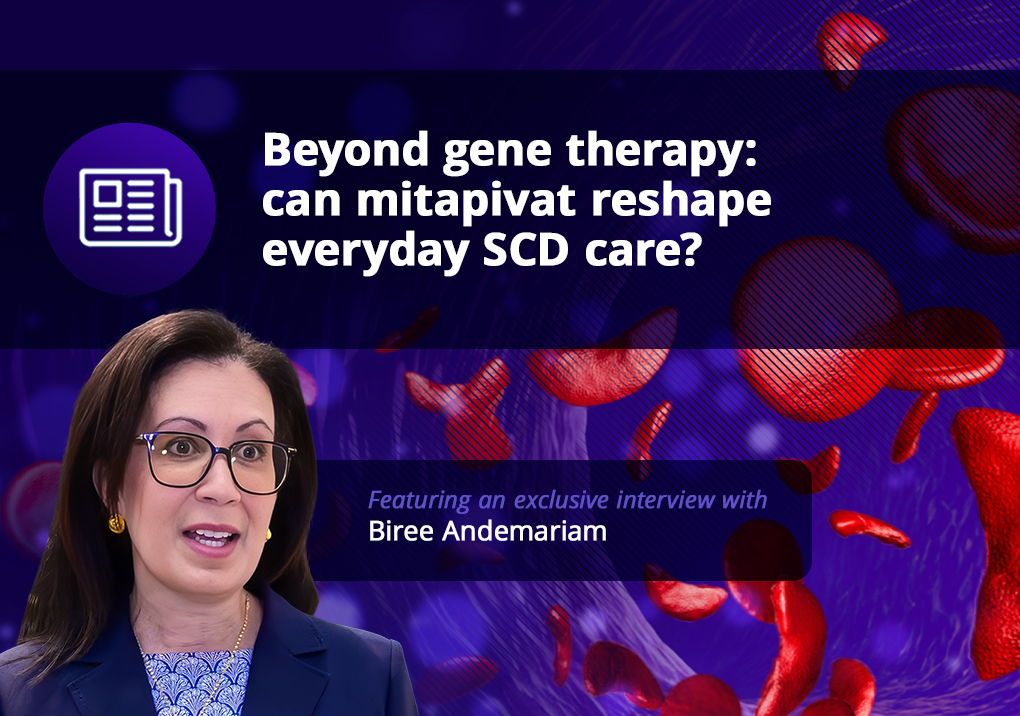
Beyond gene therapy: can mitapivat reshape everyday SCD care?
The therapeutic landscape for sickle cell disease (SCD) continues to evolve rapidly, with gene therapies offering a potentially curative treatment option for selected patients. However, these approaches are currently suitable for only a subset of individuals. Gene therapy requires collection and genetic modification of a patient’s own hematopoietic stem cells, followed by myeloablative conditioning with high-dose chemotherapy and reinfusion of the modified cells.1 This intensive, complex process takes place in specialized treatment centers and can present substantial practical and clinical barriers to treatment. Consequently, many patients continue to rely on pharmacological disease-modifying therapies for long-term disease management. Despite advances in disease management, acute vaso-occlusive complications remain a major therapeutic challenge, while chronic hemolytic anemia, fatigue, and transfusion burden continue to contribute substantially to morbidity. Together, these ongoing unmet needs highlight the importance of therapies that address both the acute and chronic manifestations of SCD.2, 3
Mitapivat, an oral pyruvate kinase activator approved for the treatment of anemia in adults with alpha- and beta-thalassemia in December 2025, is being investigated as a novel disease-modifying therapy for SCD.4 Clinical data in thalassemia have demonstrated the potential of pyruvate kinase activation to improve anemia and reduce transfusion burden, providing clinical precedent for targeting red-cell metabolism in inherited hemoglobin disorders.4 In SCD, preclinical and early clinical studies have provided a rationale for investigating mitapivat, with evidence suggesting that pyruvate kinase activation may increase hemoglobin levels, reduce hemolysis, and improve red blood cell function and sickling parameters.5 At the 2026 European Hematology Association (EHA) Congress, Biree Andemariam, MD, University of Connecticut, Farmington, CT, presented top-line results from the Phase III RISE UP trial (NCT05031780), a global, randomized, placebo-controlled study evaluating mitapivat in 207 patients with SCD.6
RISE UP evaluated hemoglobin response (defined as a ≥1.0 g/dL increase in average hemoglobin concentration from Week 24 to Week 52 compared with baseline) and the annualized rate of sickle cell pain crises as co-primary endpoints. The study met the co-primary endpoint of hemoglobin response, with 40.6% of patients (56/138) in the mitapivat arm achieving this endpoint, compared with 2.9% of patients (2/69) in the placebo arm (2-sided p<0.0001).6 Improvements in markers of hemolysis were also observed. Although the trial did not demonstrate a statistically significant reduction in the annualized rate of sickle cell pain crises across the overall study population, hemoglobin responders had a 26% lower annualized rate of pain crises and 34% fewer related hospitalizations than non-responders in a post-hoc analysis.
In an exclusive video interview, Dr Andemariam highlighted the differences observed between hemoglobin responders and non-responders:
“What we saw in that subgroup analysis is that hemoglobin responders actually had a reduction in sickle cell pain crises annually, as well as the sickle cell pain crises that require hospital visits or ER visits. It also reduced their length of hospital stay. It also improved their fatigue, and fatigue is one of the most important symptoms that individuals living with sickle cell disease struggle with.”
The RISE UP findings build on growing evidence supporting pyruvate kinase activation as a disease-modifying strategy in inherited hemoglobin disorders, adding Phase III clinical evidence for mitapivat in SCD alongside its established use in thalassemia. While reducing vaso-occlusive complications remains a principal treatment objective, chronic hemolytic anemia is also associated with fatigue, impaired quality of life, cumulative organ damage, and increased transfusion requirements.2, 3 Consequently, therapies that improve hematological parameters and reduce transfusion burden may provide clinically meaningful benefits that extend beyond the prevention of acute pain episodes.
As the therapeutic armamentarium for SCD continues to expand, understanding how emerging therapies can be integrated into routine clinical practice for different patient populations will become increasingly important. While gene therapies have transformed the treatment landscape for selected patients, oral disease-modifying therapies are likely to remain central to SCD management across a broad patient population. Mitapivat represents one such emerging approach and is currently under U.S. Food and Drug Administration (FDA) Priority Review for the treatment of SCD, with a Prescription Drug User Fee Act (PDUFA) target action date of November 1, 2026.7 In parallel, the global confirmatory Phase III REIGNITE study (NCT07656415) is expected to further evaluate the long-term efficacy and safety of mitapivat in SCD.7 Together with longer-term follow-up from RISE UP, these studies will help determine whether mitapivat can deliver durable improvements in both hematological and patient-centered outcomes, and how it may ultimately be integrated into future SCD treatment strategies.
References
- U.S. Food and Drug Administration. FDA approves first gene therapies to treat patients with sickle cell disease. 2023. Available from: https://www.fda.gov/news-events/press-announcements/fda-approves-first-gene-therapies-treat-patients-sickle-cell-disease. Accessed September 2026.
- Idowu M, Otieno L, Dumitriu B, et al. Safety and efficacy of mitapivat in sickle cell disease (RISE UP): results from the phase 2 portion of a global, double-blind, randomised, placebo-controlled trial. Lancet Haematol. 2025;12(1):e35-e44. doi:10.1016/S2352-3026(24)00319-3.
- Glenthøj A. Beyond adenosine triphosphate: unveiling the pleiotropic effects of pyruvate kinase activation in sickle cell anemia. Haematologica. 2024;109(8):2020-2022. doi:10.3324/haematol.2024.285390.
- U.S. Food and Drug Administration. FDA approves first oral treatment for anemia in thalassemia, an inherited blood disorder. 2025. Available from: https://www.fda.gov/drugs/news-events-human-drugs/fda-approves-first-oral-treatment-anemia-thalassemia-inherited-blood-disorder .Accessed September 2026.
- D’Alessandro A, Le K, Lundt M, et al. Functional and multi-omics signatures of mitapivat efficacy upon activation of pyruvate kinase in red blood cells from patients with sickle cell disease. Haematologica. 2024;109(8). doi:10.3324/haematol.2023.284831.
- Andemariam B, Kuo KHM, Algahtani F, et al. Efficacy and safety of mitapivat in sickle cell disease: results from the global, randomized, Phase 3 rise up trial. Abstract S102. EHA 2026 Congress, 10-14 June, 2026.
- Agios Pharmaceuticals. Agios announces FDA Priority Review for supplemental New Drug Application for mitapivat in sickle cell disease and initiation of the confirmatory Phase III REIGNITE trial. 2026. Available from: https://investor.agios.com/news-releases/news-release-details/us-fda-grants-priority-review-agios-snda-mitapivat-sickle-cell. Accessed August 2026.
Written by Ellen Jackson
Edited by Natalie Markova
