ASH 2025 | Predictive factors for successful treatment-free remission in CML
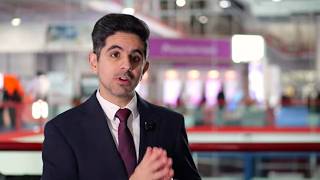
Fadi Haddad, MD, The University of Texas MD Anderson Cancer Center, Houston, TX, discusses a pooled analysis evaluating predictive factors for successful treatment-free remission (TFR) in patients with chronic myeloid leukemia (CML). The analysis found sustained deep molecular remission, particularly of long duration, as the strongest predictor of durable TFR. This interview took place at the 67th ASH Annual Meeting and Exposition, held in Orlando, FL.
These works are owned by Magdalen Medical Publishing (MMP) and are protected by copyright laws and treaties around the world. All rights are reserved.
Transcript
Now we move to treatment-free remission, and this is a very relevant, I would say, endpoint that we have been discussing over the past few years on patients with chronic myeloid leukemia. And for this, we pulled data from MD Anderson Cancer Center and Centre Léon-Berard in Lyon, France, and we have more than 400 patients that we reviewed and analyzed, treated with various types of TKIs, imatinib, dasatinib, nilotinib, bosutinib, or ponatinib, in the frontline setting...
Now we move to treatment-free remission, and this is a very relevant, I would say, endpoint that we have been discussing over the past few years on patients with chronic myeloid leukemia. And for this, we pulled data from MD Anderson Cancer Center and Centre Léon-Berard in Lyon, France, and we have more than 400 patients that we reviewed and analyzed, treated with various types of TKIs, imatinib, dasatinib, nilotinib, bosutinib, or ponatinib, in the frontline setting. Some of them went ahead and switched therapy for different causes, and then eventually all those patients discontinued TKI therapy. And we looked at the causes of discontinuation. Three-quarters of the patients, or 76%, discontinued therapy because they achieved a very good response, what we call deep molecular remission. This is when their level of disease by PCR is less than 0.01%. Some other patients discontinued treatment because of side effects, financial reasons, and others. And we looked, and we followed those patients over time, and after a median follow-up of about five years, the five-year treatment-free remission rate was significant. Overall, I would say it was close to 60% in those patients. And then we stratified those patients to see who did better than others. And we found that patients who were in a deep molecular remission for five years or longer had the better outcomes and had a five-year TFR rate of more than 70, even more than 80% compared to patients who had a lower duration of deep molecular response where the five-year TFR was less than that. So in practice, what do we recommend for our patients with CML who are responding well to therapy? If they achieve a sustained and deep molecular response for five years or longer, they are the best candidates to discontinue therapy and maybe be functionally cured of CML in more than 70 to 80 percent of cases.
This transcript is AI-generated. While we strive for accuracy, please verify this copy with the video.
Read more...